The Problem with Patriotism by Amaan Fayez

Introduction
For most people in India, patriotism isn’t easily definable. Consequently, this kind of obscurity in people gives rise to ignorance and results in them misinterpreting what it really means. We see this ignorance in people in the form of nationalism masquerading as patriotism. And that is the real problem with patriotism in India; people’s inability to differentiate between patriotism and nationalism. Simply put, a patriot is a person who loves their country for what it does and what it stands for. On the other hand, a nationalist is a person who loves their country regardless of what it does.
Nationalism: The Curse That Keeps on Giving
Nationalism has been a growing concern as it is seen by many as an enabler of tyranny and fascism in our nation. It blinds a person from the atrocities the leaders of their beloved nation commit, it takes away their ability to form differing opinions and programs their minds to defend anything and everything without even attempting to understand it.
The reason nationalism is considered a curse is because it is a stepping stone to the cave of a much more menacing ideology; fundamentalism. An ideology that is characterized by the advocacy of strict conformity to religious texts and as a result resentment, revolt and extreme prejudice against people of other faiths. From rejection of diversity of opinion to suppression of freedom of speech, we can see the roots of fundamentalism already plaguing our nation.
The Many Faces of Patriotism
Selective Patriotism
The most common form of patriotism also happens to be the most visual kind. This is when people pride themselves on being citizens of their beloved nation only on special occasions like winning the cricket world cup, or after a successful space program, or when their nation commits war crimes in disputed territory, or when they make fictionalized and dramatized movies showcasing their nation committing war crimes in disputed territory, and finally when they see their flag hoisted on Republic Day or Independence Day. A wave of love and appreciation flows through every citizen during these beautiful moments.
Enforced Patriotism
While patriotism for most people comes naturally, there are those who coerce others to align them to their personal views. There have been attempts to correct enforced patriotism, for example, the ruling Supreme Court made in 2018 to modify its 2016 ruling to remove the mandate on movie theatres to play the national anthem. On the other hand, things have taken a turn for the worse in other parts of the country. The State Government of Gujrat started an initiative to have school students respond with “Jai Hind” or “Jai Bharat”, instead of “yes” or “present” in the daily roll call. Something similar was seen these past couple of weeks where everyone was socially obligated to smear the tricolor across their homes, offices, vehicles, etc. as part of a new campaign by the Union Government.
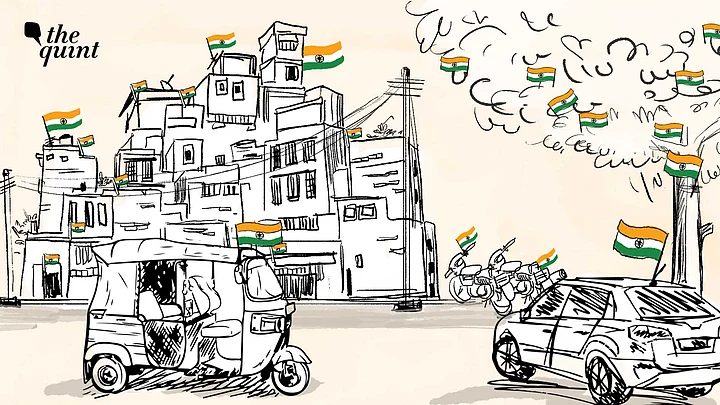
Enforcing citizens (socially or otherwise) to wear their patriotism on their sleeves is a mockery of their freedom of expression. People ought to understand that the reason not all citizens have a sense of patriotism is because not all citizens are treated the same. Even in a democracy, a government can be seen uplifting one community while suppressing and oppressing another.
True Patriotism
Conclusion
‘Freedom in The World’ is a report conducted by Freedom House, a non-profit set up by Eleanor Roosevelt that conducts research on democracy, political freedom, and human rights. This report measures and rates people’s access to political rights and civil liberties in each country on a scale of 0 to 100, to measure the Annual Freedom in The World. And as per the latest report, India gathered a score of 66 which falls under the category of ‘partially free’.

Until 75 years ago, India was colonized and governed by The British, and today India is governed by Indians and we have a tendency to equate independence of being self-governed as ‘freedom’ when the right term for that is ‘sovereignty’. Freedom is something we’re fighting for to this day. We fight for freedom when we protest unjust regimes, when farmers are beaten and tear-gassed, when minorities are demonized and lynched, when journalists and activists are arrested with no legitimate grounds under draconian laws and when several other atrocities are committed.
This Independence Day, I hope we understand the true meaning of patriotism and the dangers of enforcing it on others and envision what a truly free nation would look like, and work towards building the same.
Well written.
ReplyDelete